
KRA Tax Compliance Certificate: Requirements and Application in Kenya
Have you ever applied for a government tender, started a new job, or needed to prove that your taxes are in order? You have probably come across the KRA Tax Compliance Certificate (TCC).
It sounds like a simple document—and the application itself is fairly straightforward. The part that catches many people off guard is that KRA doesn’t simply issue the certificate to you because you’ve requested it. Your tax records have to be compliant first.
So, what exactly does KRA look at? And how do you apply for the certificate?
Let’s walk through it.
What is a KRA compliance certificate?
A Tax Compliance Certificate (TCC) is an official document issued by the Kenya Revenue Authority (KRA) to show that a taxpayer has met the required tax compliance conditions.
It’s sometimes also called a KRA Tax Clearance Certificate.
The certificate can be required when you’re applying for certain jobs, government tenders, licences, work permit renewals and other services. A TCC is valid for 12 months.
For a business owner, having a valid TCC can also be useful when dealing with organisations that require proof that your tax affairs are up to date.
Who Can Apply for a KRA TCC?
Both individuals and businesses can apply for a Tax Compliance Certificate, provided they meet the applicable compliance requirements.
For an individual earning only employment income, the requirements can be different from those applying to someone who operates a business.
This distinction has become particularly important because KRA has enhanced the TCC process to include TIMS/eTIMS compliance for people carrying on business.
KRA Tax Compliance Certificate Requirements
TCC requirements Kenya
Before you apply, it’s worth checking your KRA account first.
According to KRA, the main requirements include:
1. File all applicable tax returns
You should file all the tax returns that apply to your KRA PIN by their respective deadlines.
This can include annual income tax returns and other returns applicable to your tax obligations.
If you did not earn any income during a particular financial year, you are required to file a nil return, depending on your tax obligation.
2. Pay taxes due on time
Filing returns is only part of compliance.
If your returns show that you have tax to pay, the required tax should also be paid. Outstanding tax can affect your TCC application.
3. Clear outstanding tax liabilities
If your KRA records show you have outstanding tax liabilities, you generally need to settle them before receiving your certificate.
KRA also provides for an approved payment plan in applicable cases.
Where an approved payment plan is in place, you may now proceed with the self-service TCC application.
4. Be compliant with eTIMS/TIMS where applicable
This is an important requirement for people running businesses.
KRA has enhanced the TCC process so that non-individual entities and individuals earning income other than employment income need to be compliant with the applicable TIMS/eTIMS requirements.
So if you run a business, don’t only check your tax returns. Check your eTIMS/TIMS status too.
5. Meet VAT requirements where applicable
If you are a VAT-registered taxpayer, you have to meet the relevant VAT compliance requirements.
KRA specifically mentions VAT compliance, including VAT Special Table status where applicable, as part of the enhanced TCC requirements.
How to Apply for a KRA Tax Compliance Certificate
Tax clearance certificate
The application is normally made through the KRA iTax portal.
Here’s the basic process:
Step 1: Log in to iTax
Go to the KRA iTax portal and log in using your KRA PIN and password.
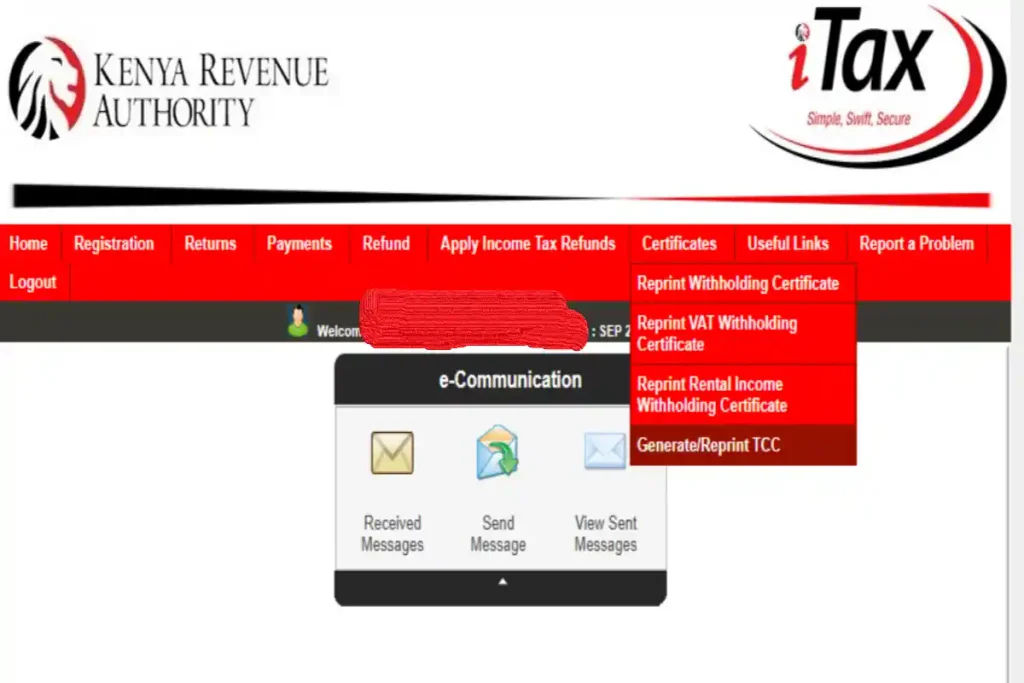
Step 2: Go to the Certificates section
Once you’re inside your iTax account, go to the CERTIFICATES section.
Select the option to Apply for Tax Compliance Certificate.
Step 3: Give the reason for the application
Your taxpayer details are generally extracted from your iTax profile. You’ll need to provide the required information, including the reason for requesting the certificate.
Step 4: Submit the application
Review the information before submitting.
An acknowledgement receipt is generated after the application is submitted.
Step 5: Wait for the certificate
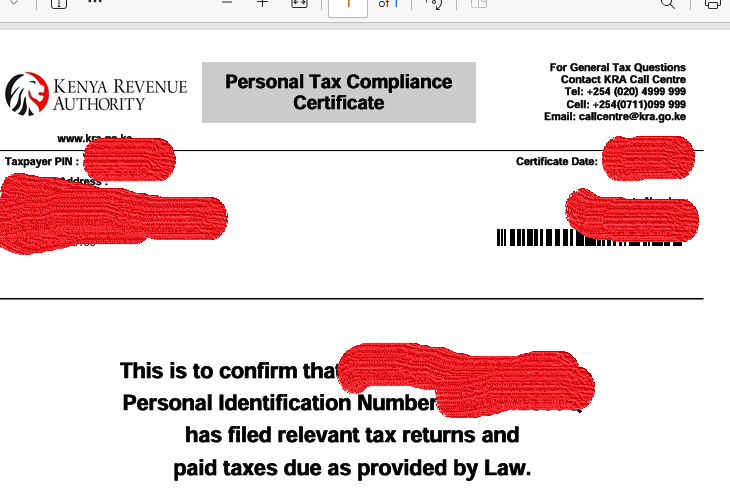
If your tax affairs are compliant, KRA processes the application and sends the TCC to your registered email address.
KRA currently indicates that successful applicants receive the certificate by email, while unsuccessful applicants are notified of the areas of non-compliance.
Why Is My KRA TCC Application Rejected?
This is one of the most common questions taxpayers ask.
Usually, the issue isn’t the application itself. There’s something in your tax records that needs attention.
For example, you may have:
- An unfiled tax return
- An unpaid tax balance
- Outstanding tax liabilities
- An eTIMS/TIMS compliance issue where applicable
- A VAT compliance issue
- Another tax obligation that hasn’t been properly addressed
If your application is unsuccessful you notified of the areas of non-compliance.
So, don’t simply keep submitting the application if it fails. First identify and resolve the compliance issue.
How Long Is a KRA Tax Compliance Certificate Valid?
Your KRA Tax Compliance Certificate is valid for 12 months from the date of issue.
If you’re using the certificate for a tender, job or licence application, it’s therefore important to check that the certificate will still be valid when you submit your documents.
You can also verify the validity of a TCC using KRA’s certificate verification services.
What Is the Difference Between a KRA PIN and a Tax Compliance Certificate?
These two documents are often confused, but they serve different purposes.
Your KRA PIN identifies you as a taxpayer and is used when dealing with KRA and various government services.
Your Tax Compliance Certificate, on the other hand, shows that you’ve met the relevant tax compliance requirements.
Having a KRA PIN doesn’t automatically mean that you have a valid TCC.
You can have a PIN but still have issues such as unfiled returns or outstanding tax liabilities that prevent you from obtaining a compliance certificate.
What If You Have No Income?
Having no income doesn’t necessarily mean you can ignore your KRA obligations.
If you have an active tax obligation that requires filing, you may need to submit the appropriate return, including a nil return where applicable.
This is why it’s a good idea to check your iTax account before applying for a TCC rather than assuming that having no income means your tax records are automatically compliant.
TCC for Businesses: What Should You Check First?
Tax clearance certificate
If you’re applying for a TCC for a company, partnership or other business, don’t just check whether the annual returns have been filed.
Look at the wider tax picture.
Check your applicable tax returns, payments, outstanding liabilities, VAT status where applicable, and eTIMS/TIMS compliance. KRA’s enhanced TCC requirements make these areas particularly important for taxpayers carrying on business.
Getting these issues sorted out before submitting your TCC application can save you from unnecessary delays.
Final Thoughts
A KRA Tax Compliance Certificate is more than just another document to download from iTax. It reflects your current tax compliance status.
The application itself is relatively simple. The important part is making sure your tax affairs are in order before you apply.
If you’re preparing for a job application, government tender, licence application or business transaction, check your KRA records early. That way, if there’s an unfiled return, outstanding liability or eTIMS issue, you’ll have time to resolve it before you actually need the certificate.
For businesses and individuals who aren’t sure whether their KRA obligations are up to date, getting professional tax assistance can also help identify compliance issues before submitting the TCC application.
And that’s why Bzinex we are here to help you get your KRA Tax Compliance Certificate. You can call us or Whatsapp +254 797 532 345 now.
ALSO READ:
Get Your KRA Tax Compliance Certificate Now – BziNex